
Most men who buy on Mallorca have been coming for years. The island is familiar, the purchase is not. Which part of the island suits which life, what the process looks like from the first viewing to the notary, what it costs on top of the price, what to check before you sign, and how to choose the agent who will walk you through it.
It usually starts at a dinner table. The fourth or fifth summer on the island, a rented house that feels like your own, a conversation that ends with someone saying that you could just buy something. Mallorca makes that thought easy. It is two hours from most of northern Europe, open all year, with a capital that works in January as well as in August. And it makes the purchase itself harder than it looks, because the island is small, the good houses are few and Spanish property law has its own rhythm.
This is the order in which to think about it: where, how, what it costs, what to check and who helps you.
First, the part of the island
Mallorca is around a hundred kilometres across, and each region asks for a different life. Decide that before you look at a single house.
- The southwest. Port d'Andratx, Camp de Mar, Santa Ponsa and Bendinat: marinas, sea views, international neighbours and the highest prices on the island. For the man who wants the boat in front of the house and Palma twenty minutes away.
- Palma. The old town, Santa Catalina, Portixol and Son Vida above the city. An apartment or a townhouse with restaurants, the cathedral and the airport within reach, and a place that lives all year rather than for one season.
- The Tramuntana. Deià, Valldemossa, Sóller and Fornalutx: stone houses, mountains falling into the sea, a landscape listed as a UNESCO World Heritage Site since 2011. Beautiful and strictly protected, which means what you see is close to what you will ever be allowed to build.
- The north. Pollença and Alcúdia, long bays, calmer water, family summers. Quieter than the southwest and good for a house that the children will want to come back to.
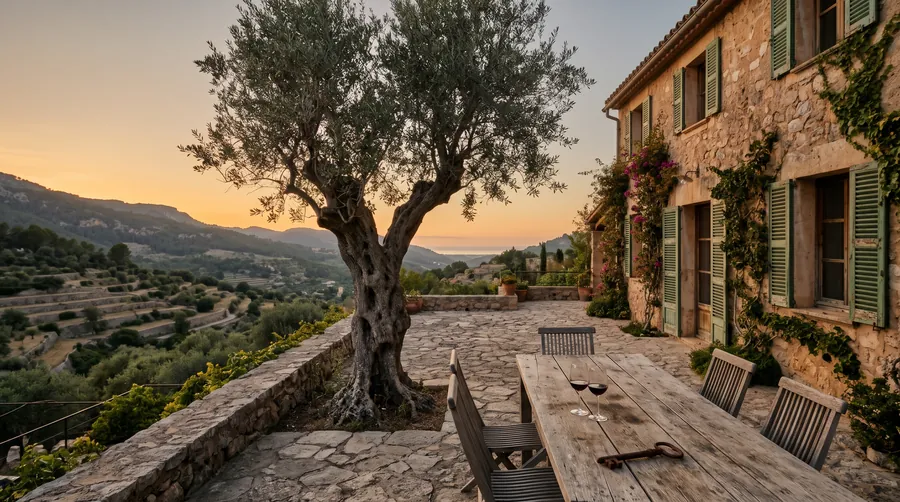
- The east and the southeast. Santanyí, Artà, the countryside between them: fincas among almond trees and stone walls, small coves, a slower island. For the man who wants land, silence and a long table outside.
The process, step by step
Buying in Spain is orderly once you know the sequence. It is also unforgiving if you skip a step.
- The NIE. Every foreign buyer needs a Spanish tax identification number, the NIE, and in practice a Spanish bank account. Apply early, it can take weeks.
- The reservation. Once you have found the house, a small reservation deposit often takes it off the market for a few weeks while the checks are done.
- The private contract. Next comes the private purchase contract, usually an arras contract with a deposit of around ten percent. If you walk away, you lose the deposit. If the seller pulls out, it usually has to be paid back twice over.
- The notary. Completion takes place before a Spanish notary, who reads the deed, checks identities and payments and certifies the sale. Keys change hands the same day.
- The registry. Afterwards the deed is entered in the Land Registry. Only then is the house yours in the eyes of everyone else.
What it costs on top of the price
The price on the listing is not the price you pay. For a resale property, the Balearic Islands charge a transfer tax on a progressive scale that starts at eight percent and reaches thirteen percent for the most expensive homes. A new build carries ten percent VAT instead, plus stamp duty. Add the notary, the Land Registry, your lawyer and, if you borrow, the costs of the mortgage. A sensible rule is to plan for ten to fifteen percent on top of the purchase price, more at the top end of the market. In Mallorca the agent's commission is usually agreed with the seller, but ask, and have it in writing.
Then there are the running costs: the annual property tax, the waste charge, insurance, a gardener, a pool man and, for most owners, someone who looks after the house while they are away. For a finca with land, this is a real line in the budget, not a footnote.
What to check before you sign
Most problems with Mallorcan houses are not hidden in the walls. They are hidden in the paperwork, and an independent lawyer finds them before the deposit is paid.
- The registry extract. The nota simple from the Land Registry shows who owns the house and whether there are mortgages or charges on it. It should match the seller, the address and the land you were shown.
- What is built against what is permitted. On rustic land in particular, extensions, pool houses and terraces were often added without a licence. Compare the registry, the land survey and the house you saw. What is not legal now will not become legal after you buy it.
- The licence to live in it. A habitation certificate and, for newer houses, the first occupation licence show that the house may be lived in at all.
- Letting it out. If you plan to rent the house to holiday guests, check the holiday rental licence before you buy, not after. The rules on Mallorca are strict, licences belong to specific properties and new ones are hard or impossible to obtain in many places, apartments in Palma among them.
- The coast. For a house close to the sea, the Spanish Coastal Law can limit what you may build, rebuild or even repair. Ask before you fall for the view.
How to choose the agent
On Mallorca a good part of the best houses never appears on a public portal. They are sold quietly, through agents who know the owners and know which family is thinking about selling before it has decided. That makes the choice of agent the most important decision after the region itself, and the one most buyers make too quickly.
- Time on the island. Prefer an agency that has been on Mallorca for many years and has an office in the area you are looking at. The southwest and the Tramuntana are different markets, and local knowledge does not travel well.
- Listings of their own. Ask how many houses they sell exclusively and how many they only share with others. An agent with exclusive listings has the seller's trust and usually the better information.
- Quiet access. Ask openly about houses that are for sale without being advertised. A serious agent will not show you everything at once, but they will tell you whether such houses exist in your budget.
- Clear roles. Know who pays the commission, and keep your lawyer independent of the agent. A good agent will welcome that rather than recommend their own.
- Language and follow-through. You will sign Spanish documents. You want an agent who explains them in your language and who is still there after the notary, when you need a builder, a pool company or someone to hold the keys.
Meet two or three agencies before you choose one, and judge them less by the houses they show you on the first day than by the questions they ask you.
Good to know
- Spring and autumn are the best months to view. In August half the island is on holiday, including some of the sellers.
- Drive the road to the house at night and in the rain before you buy it. A beautiful finca at the end of a bad track is a different house in February.
- Count the minutes to the airport, the nearest pharmacy and a good bakery. They matter more after the third summer than the size of the pool.
- Keep every document from the purchase in one folder, in paper and digitally. You will need it again when you sell.
Try the tool
Home BarWhat can you make tonight?Questions we get asked
Can foreigners buy property on Mallorca?
Yes. Buyers from inside and outside the EU can buy on Mallorca. Every foreign buyer needs a Spanish tax identification number, the NIE, and in practice a Spanish bank account for the payments.
How much does it cost to buy a house on Mallorca on top of the price?
Plan for roughly ten to fifteen percent of the purchase price for taxes, notary, Land Registry and lawyer, more at the top end. For resale homes the Balearic transfer tax runs on a scale from eight to thirteen percent, new builds carry ten percent VAT plus stamp duty.
Do I need a property agent to buy on Mallorca?
You do not have to use one, but many of the best houses on the island are sold quietly through agents and never advertised. Choose an agency with long experience in the area you are looking at, ask who pays the commission and keep your own lawyer independent of the agent.
Can I rent out my house on Mallorca to holiday guests?
Only with a valid holiday rental licence for that specific property. The rules are strict and new licences are hard or impossible to get in many places, so check the licence before you buy.