
A classic yacht is a century of craft that you can sail. Teak decks, bronze winches, hulls planked by hand and lines drawn by the great designers of the Clyde and New England. Who drew them, where to see them race, what it takes to keep one and how to step aboard without owning one.
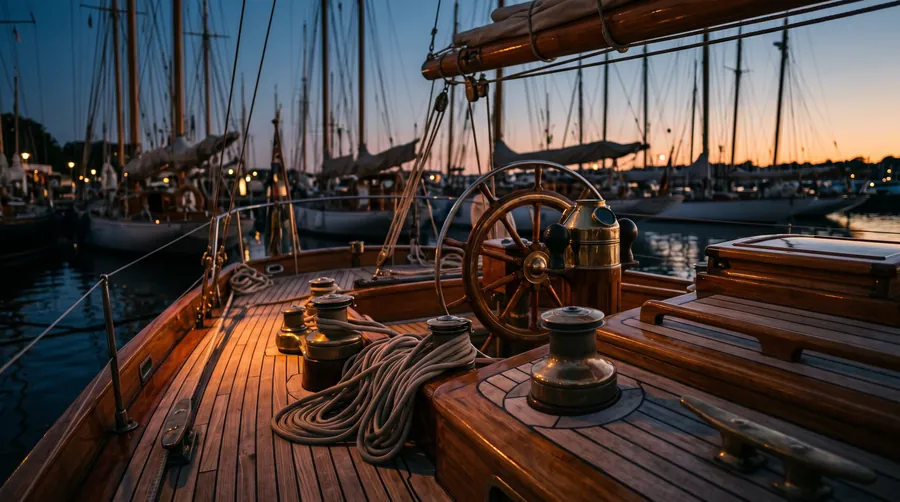
Walk along the quay at Saint-Tropez at the end of September and you will understand why men fall for old boats. The hulls are dark blue, white or varnished mahogany, the masts are wood, the decks are scrubbed teak and the fittings are bronze, polished by a crew that started at seven. Some of these yachts were launched before the First World War. They are not museum pieces. They race, in a breeze, a few metres apart.
The designers
Two names explain much of what you see. William Fife III, born in 1857 in Fairlie on the Firth of Clyde, was the third generation of a family of Scottish yacht builders and is credited with around six hundred designs. After the success of his yacht Dragon in 1888 he adopted a carved dragon as his trademark, and you can still find it in the scrollwork on the bows of his boats. Fife drew two America’s Cup challengers for Sir Thomas Lipton, Shamrock I and Shamrock III, and yachts such as Moonbeam III, Mariquita and Tuiga still sail today. Across the Atlantic, Nathanael Greene Herreshoff, known as Captain Nat, founded the Herreshoff Manufacturing Company in Bristol, Rhode Island, in 1878 together with his brother John, and designed five America’s Cup defenders between 1893 and 1920. Every one of them won.
Then there are the metre boats. Under the International Rule of 1907, a 6, 8 or 12 Metre is not six, eight or twelve metres long; the number is the result of a formula that combines length, sail area, girth and freeboard. A 12 Metre is around twenty metres long. The class was the America’s Cup yacht from 1958 to 1987, and many of those boats are still restored, raced and loved.
A modern yacht is a product. A classic yacht is a responsibility, handed from one owner to the next, and every owner is only its keeper for a while.
Where to see them
The Mediterranean season ends with the classics. The Régates Royales in Cannes, first sailed in 1929 in honour of King Christian X of Denmark and organised by the Yacht Club de Cannes, brings classic yachts and metre boats to the bay every September. Les Voiles de Saint-Tropez, at the turn of September and October, grew out of a challenge between two yachts in 1981, the Swan 44 Pride and the 12 Metre Ikra. It became the Nioulargue, and since 1999 the Société Nautique de Saint-Tropez has run it as Les Voiles, with classic and modern yachts racing in the same bay. Walk the quays in the morning, when the crews rig the boats, and you will learn more than in a week of reading.
Every sailing country has its own wooden boat festivals, its own classic regattas and its own yards where boats are still built and restored by hand. Visiting one, and talking to the people who work there, is the easiest way into this world.
What a wooden yacht asks of its owner
Time first, then money. A wooden hull wants to be kept in the water in summer and dry, ventilated and under cover in winter. Varnish needs fresh coats every season, teak decks are scrubbed with salt water rather than chemicals, and the seams need attention every few years. Any good yard will tell you that the cheapest classic yacht for sale is almost always the most expensive one to own. Buy the boat with the best documented restoration and a survey from a surveyor who knows wood, and budget for maintenance every single year rather than for repairs every five. Then join the class association or the owners’ club: they know the boats, the yards and the few people who can still steam a plank.
Sailing one without owning one
You do not need to buy a classic to sail one. Many classic yachts can be chartered for a day or a week with their professional crews, some owners take guests along for regattas, and sailing schools in several countries teach on traditional boats. A day on a gaff cutter teaches more about sailing than a week on a modern yacht with electric winches. You pull on real ropes, steer with a tiller or a wooden wheel and begin to understand why designers spent a century perfecting these lines.
How to dress for it
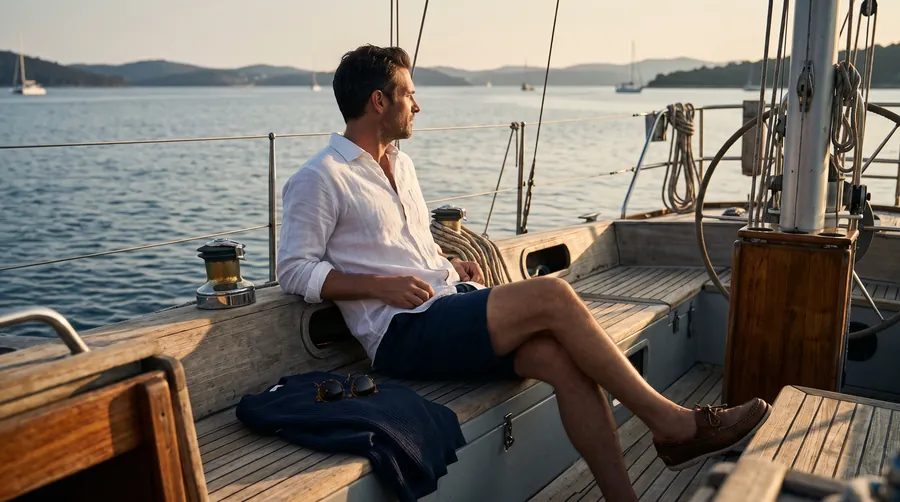
On a classic yacht, shoes with clean, pale, non-marking soles are not a style choice; they protect a teak deck that someone scrubbed by hand that morning. White and navy, cotton and linen, a knit for the evening breeze. The crew wears matching polos; the guests should look as if they belong to the same boat.
Try the tool
Charter BudgetThe boat and the bill for a week on the waterTailoring GuideYour sizes, your cut, your fitting checklistQuestions we get asked
What counts as a classic yacht?
Broadly, a yacht designed and built with traditional materials and methods, usually wood, before the age of series production in fibreglass, or a faithful replica of one. Classic regattas have their own definitions and divide the fleet into classes by age and type.
Is a wooden yacht a good investment?
Rarely in money, often in pleasure. Buy one because you want to sail and keep it. The best restored boats hold their value; the neglected ones swallow it.
Can I watch the classic regattas?
Yes. The quays in Cannes and Saint-Tropez are public, and spectator boats go out to watch the racing. Book a hotel early: in regatta week both towns are full.